Rebel: How to Overthrow the Emerging Oligarchy by Douglas Carswell
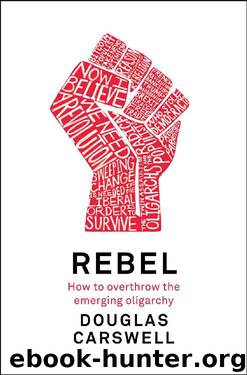
Author:Douglas Carswell [Carswell, Douglas]
Language: eng
Format: epub
ISBN: 9781786691545
Publisher: Head of Zeus
Published: 2017-03-24T22:00:00+00:00
EUROPE: A GRINDINGLY SLOW ESCAPE
Historians of the Middle Ages seem to report finding a ‘renaissance’ wherever they look. Some have claimed to have spotted a Carolingian renaissance in the eighth and ninth centuries. Others say they found one in the tenth century, while several medieval renaissances are alleged to have happened in the twelfth century. Perhaps these apparent discoveries tell us more about the tendency specialist historians have to overstate the significance of ‘their’ period of history than they do about the past.
During the Middle Ages, some progress took place. There were improvements in farming, with the adoption of a heavier, wheeled plough and the use of crop rotation. Milling technology improved, with more water mills and new designs of windmill. But the Middle Ages need to be put into perspective. Between 1000 and 1500, per-capita output in the West rose from $426 to $754 in today’s money. Or by 77 per cent stretched out over half a millennium.
There might have been some intensive growth but it was grindingly, painfully slow. We have experienced more economic expansion in the past three decades than there was in half a millennium of the Middle Ages. Indeed, growth in the Middle Ages wasn’t just slow from a modern perspective but by the standards of the Roman republic. Per-capita income in Italy doubled over a period of 300 years between 300 BC and AD 14 – more than the increase in output over 500 years in the Middle Ages.
By 1500, Europe might have progressed in relation to other parts of the world but it was by no means clear that she was ahead – certainly not militarily. She endured a series of military defeats: Wahlstatt in 1241, Nicopolis in 1396 and the Siege of Vienna in 1529 – following which the Balkans were lost to the Ottomans.
E. L. Jones, the famous Australian scholar, wrote about the ‘European miracle’. But before the sixteenth century, if not the nineteenth for many, it was an extraordinarily slow-moving miracle. In fact, progress was so slow during the Middle Ages that, after 500 years of successive renaissances, Europe’s per-capita income was still below what it had been in Italy in the first century AD.
Europe had not made enough progress between the tenth and fourteenth centuries to escape Malthusian constraints. The Black Death in the mid-fourteenth century was a brutal manifestation of this fact. From 1348 to the 1650s, a series of catastrophic plagues reduced Europe’s population by between a quarter and a third. War and famine played their part, too. In 1500, Europe’s population of 60 to 70 million was lower than its estimated 80 million in 1300. For all the progress of the Middle Ages, there was no miraculous escape from age-old constraints.
But, despite this, Europe in the Middle Ages was one of few places on the planet where there had been any intensive economic growth over the preceding two millennia. Why was it that Europe made progress, albeit so slow? Because she was steadily starting to escape the grip of the parasites.
Download
This site does not store any files on its server. We only index and link to content provided by other sites. Please contact the content providers to delete copyright contents if any and email us, we'll remove relevant links or contents immediately.
| Anthropology | Archaeology |
| Philosophy | Politics & Government |
| Social Sciences | Sociology |
| Women's Studies |
The Secret History by Donna Tartt(19002)
The Social Justice Warrior Handbook by Lisa De Pasquale(12177)
Thirteen Reasons Why by Jay Asher(8874)
This Is How You Lose Her by Junot Diaz(6857)
Weapons of Math Destruction by Cathy O'Neil(6248)
Zero to One by Peter Thiel(5767)
Beartown by Fredrik Backman(5717)
The Myth of the Strong Leader by Archie Brown(5482)
The Fire Next Time by James Baldwin(5409)
How Democracies Die by Steven Levitsky & Daniel Ziblatt(5200)
Promise Me, Dad by Joe Biden(5130)
Stone's Rules by Roger Stone(5065)
A Higher Loyalty: Truth, Lies, and Leadership by James Comey(4937)
100 Deadly Skills by Clint Emerson(4900)
Rise and Kill First by Ronen Bergman(4761)
Secrecy World by Jake Bernstein(4727)
The David Icke Guide to the Global Conspiracy (and how to end it) by David Icke(4685)
The Farm by Tom Rob Smith(4489)
The Doomsday Machine by Daniel Ellsberg(4474)
